
Dispatching now · open 24 hours Open 24 hours

Septic tank cleaning in Conroe, TX

Pumping empties the tank. Cleaning restores it. If your tank has only ever been pumped, it is carrying a layer of compacted solids that has been shrinking its working capacity for years.

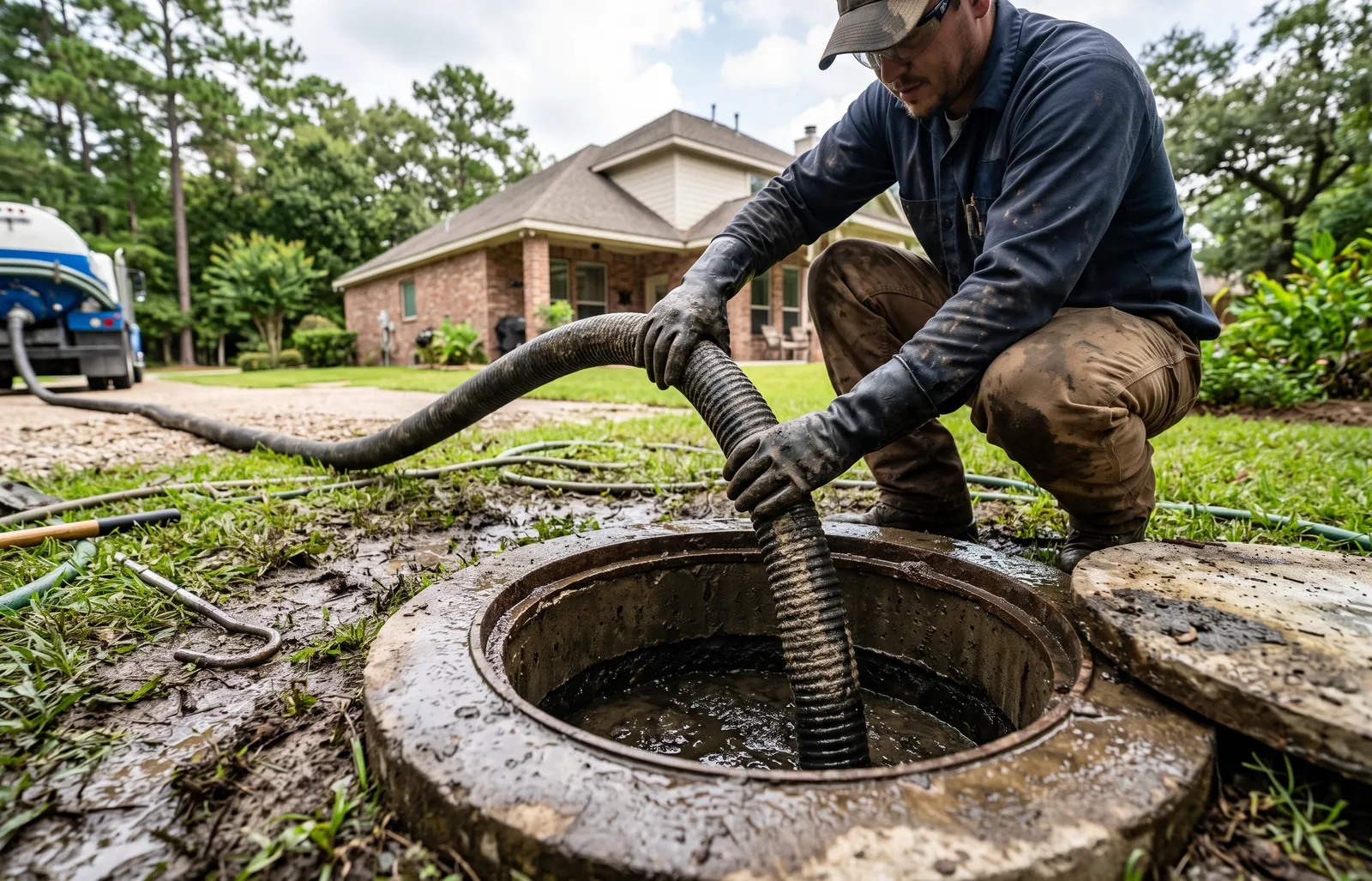
Technician feeding a suction hose into a concrete septic tank riser during a full tank cleaning

Pumping and cleaning are not the same service

This is the single most common misunderstanding in the septic trade, and plenty of companies are happy to leave it that way. The difference is straightforward.

Pumping is suction. A vacuum truck draws out the liquid and whatever solids come with it. It is quick, it is cheap, and on a tank in good condition it is exactly what you need.

Cleaning is pumping plus everything suction cannot reach. The sludge on the tank floor that has compacted into something closer to clay than liquid. The scum mat welded to the walls at the old waterline. The buildup choking the inlet and outlet baffles. Cleaning takes longer and costs more, and on a neglected tank it is the only thing that actually restores capacity.

How to tell which one you need: if the tank has been serviced on schedule every three to five years, pumping is enough. If it has been more than six years, or you do not know, or the last company was in and out in twenty minutes, it needs cleaning.

What compacted sludge does to a tank

A 1,000 gallon tank with eight inches of hardened sludge on the floor is not a 1,000 gallon tank anymore. It is functionally a 700 gallon tank, which means wastewater passes through it faster than solids can settle. Those solids leave with the effluent and land in the drain field, where they clog the soil pores that make the field work.

Drain fields cannot be cleaned. Once the soil is sealed with solids, the only fix is a new field, and that is excavation, permits and a five-figure invoice. Cleaning the tank properly is the cheapest insurance available against that outcome.

When cleaning is the right call

  • The tank has gone more than six years without service, or the history is unknown.
  • You just bought the property and want a documented baseline.
  • Drains were still sluggish after a recent pump out.
  • The last service was noticeably fast, which usually means only the liquid came out.
  • You are selling and want a clean report to hand the buyer.
  • There is a persistent odor even though the tank is not full.

Grease trap cleaning uses the same principle

Restaurant grease traps fail for the same reason neglected septic tanks do: the hardened layer never comes out. We clean traps down to bare walls, scrape the baffles, and leave you the disposal manifest your health inspector will ask for. That work lives on our commercial services page.

The full clean

What a real septic cleaning covers

Everything below is part of the cleaning service. If a quote you are comparing does not name these, it is a pump out with a different label.

Complete evacuation

Liquid, sludge and scum removed in full, including the compacted layer on the tank floor.

Wall and floor scouring

The hardened residue at the old waterline and on the floor is broken up and drawn out, not left in place.

Baffle clearing

Inlet and outlet baffles cleaned back to full opening, then checked for cracks and missing sections.

Interior inspection

Once the tank is empty we photograph the walls, joints and baffles and flag any structural problems.

Condition report

A written assessment of tank condition with photos, useful for a sale, an inspection or your own records.

Permitted disposal

All waste hauled to a licensed Texas facility, with manifests available.

How it runs

How a cleaning visit runs

Longer than a pump out because the work does not stop when the tank empties. That is the whole point.

  1. Access and measure

    Lids uncovered, sludge and scum depths recorded so you can see the starting condition.

  2. Evacuate

    The tank is drawn down completely, including whatever the vacuum can lift from the compacted layer.

  3. Break down and scour

    What suction left behind gets broken up, the walls and baffles are worked over, and the residue is pumped out.

  4. Inspect and report

    Empty tank photographed and assessed. Findings, photos and your next service date sent the same day.

Straight answers

Septic cleaning questions

If yours is not here, call or text. We answer it on the phone without sending a truck first.

Ask us directly

Pumping removes the liquid and whatever solids the vacuum can lift. Cleaning removes everything: the compacted sludge on the floor, the scum mat on the walls, and the buildup on the inlet and outlet baffles. A tank that is only ever pumped keeps a solids layer that shrinks its working capacity year after year.

Two signals. First, service history: if the interval has been longer than six years, or nobody can tell you the last date, assume it has not. Second, visit length: a genuine cleaning on a neglected tank takes well over an hour. A twenty minute visit was a pump out.

No. The work is mechanical agitation and suction, not pressure blasting against the walls. If the tank has existing cracks or a failing baffle, cleaning is when we find them, because an empty tank is the only time anyone can actually see the inside.

It depends on how compacted the solids are, which is not knowable until we open the tank. We quote a range on the phone that covers both scenarios and confirm the number on site before starting.

No, and any company that says otherwise is selling you something. Once solids have sealed the soil in the drain field, the field has to be replaced. Cleaning the tank stops the damage from continuing, which is why doing it before the field fails matters so much.

Tank overdue by years, not months?

The longer compacted sludge sits, the more of it ends up in the drain field. Call and we will tell you what you are dealing with.

Text us